Nutritional Intelligence: Calorie Calculator by Food
Search from 200+ Indian & Global foods, add portion sizes, and calculate total calories, protein, carbs, and fats.
| Food Item | Quantity | Calories | Macros (P / C / F) | Action |
|---|
Calorie Calculator by Food: Track 200+ Foods, Daily Calories, and Macronutrients
Achieving any fitness goal—whether losing stubborn fat, building lean muscle mass, or maintaining a healthy lifestyle—comes down to energy balance. While broad dietary guidelines offer general advice, real progress requires understanding the exact nutritional profile of the meals you eat daily.
An interactive Calorie Calculator by Food takes the complexity out of dietary tracking. By searching through a database of 200+ everyday cooked dishes, staples, raw ingredients, and beverages, you can calculate your total caloric intake along with a breakdown of protein, carbohydrates, and fats in real time.
Why Food-Based Calorie & Macro Tracking Matters
Your body requires a baseline amount of energy every day to support basic metabolic functions and physical activities. Tracking the nutritional density of individual food items provides distinct advantages:
Accurate Caloric Deficit or Surplus: Weight loss requires consuming slightly fewer calories than you burn, whereas muscle gain requires a controlled caloric surplus. Consistent tracking prevents underestimating portion sizes.
Macronutrient Optimization: Calories determine overall weight change, but macronutrient ratios dictate body composition. Tracking protein ensures muscle preservation, while monitoring healthy fats and complex carbohydrates sustains hormonal health and daily energy.
Long-Term Body Composition Improvements: Pair dietary tracking with periodic biometric check-ins—such as an accurate calculation of body fat percentage—to evaluate whether your weight loss is coming from body fat rather than lean tissue.
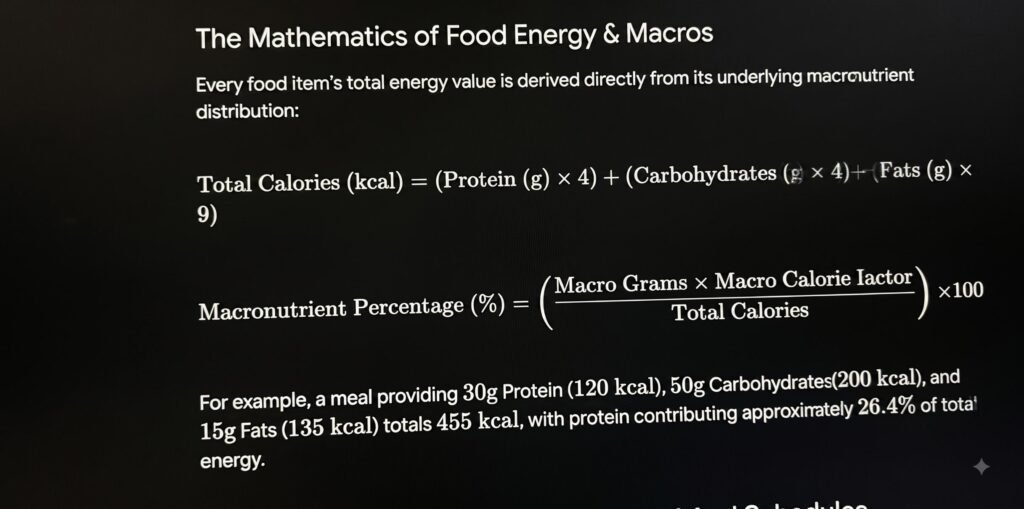
| Macronutrient | Calories per Gram | Primary Role in the Body | Recommended Daily Share |
| Protein | $4\text{ kcal/g}$ | Muscle repair, tissue synthesis, satiety | 20% – 35% |
| Carbohydrates | $4\text{ kcal/g}$ | Primary cellular fuel and glycogen replenishment | 45% – 60% |
| Fats | $9\text{ kcal/g}$ | Hormone production, cell membrane structure | 20% – 35% |
How to Use the Calorie Calculator by Food
Filter by Category: Select a category (such as Indian Breads & Grains, Rice & Dals, Sabzi & Curries, Meat & Eggs, or Snacks) to narrow your search.
Choose Your Item: Pick the specific food item from the verified database of over 200 items.
Adjust the Servings: Enter the number of servings, pieces, cups, or bowls consumed based on standard household measures.
Add to Meal: Click + Add to Meal to log the item in your session table.
View Instant Totals: Click Calculate Total Calories to launch the comprehensive nutrition summary modal displaying cumulative energy ($\text{kcal}$), total grams of Protein, Carbs, and Fats, and their respective percentage contributions.
Structuring Your Nutrition Plan Around Real Schedules
A successful nutrition regimen depends on timing and consistency. Short-term adjustments, such as rehydrating and balancing electrolytes over a focused window like 72 hours from now, can help reset digestion after social events.
For broader lifestyle goals, tracking meal prep across a defined block—like 10 days from today—provides an effective trial period to measure how your body responds to a specific caloric target. If you balance busy work schedules, using a dedicated business day calculator ensures you can plan weekly batch-cooking and grocery prep around actual corporate working days.
Practical Tips for Accurate Meal Logging
Account for Cooking Oils & Ghee: Added fats are calorically dense ($9\text{ kcal/g}$). Even a single teaspoon ($5\text{g}$) of oil or ghee adds approximately $45\text{ kcal}$ to an otherwise lean meal.
Distinguish Raw vs. Cooked Weights: Grains like rice, oats, and lentils absorb water and expand 2 to 3 times in weight during cooking, whereas meats lose water and shrink. Ensure your logged portions reflect cooked household servings.
Don’t Overlook Liquid Calories: Fruit juices, sweetened chai, coffees, and sodas contribute carbohydrates without promoting satiety. Logging beverages keeps total daily energy in check.